
Dirty Frag – Critical Linux Kernel Privilege Escalation Threat
Dirty Frag describes a new class of Linux Kernel vulnerabilities that may allow a local attacker to gain root privileges on widely used Linux distributions under certain conditions.
Management Summary
Dirty Frag is a new Local Privilege Escalation vulnerability class in the Linux Kernel. The attack technique is based on Page Cache write primitives and combines two Kernel paths: xfrm-ESP and RxRPC.
The vulnerability is particularly critical because the attack does not rely on classic race conditions and has reportedly been demonstrated successfully on several major Linux distributions. For organisations, this means that any compromised local user, container workload or web service account may potentially be escalated to full root compromise.
Dirty Frag is considered a conceptual evolution of Copy Fail, a Linux Kernel Local Privilege Escalation vulnerability referenced as CVE-2026-31431. While Copy Fail already demonstrated the risk of controlled Page Cache manipulation, Dirty Frag expands this attack class by combining additional Kernel components.
Technical Overview
Dirty Frag abuses a Linux Kernel vulnerability class where specific Kernel interfaces may enable controlled write operations into the Page Cache. The Page Cache is a central Kernel mechanism used to efficiently cache file contents in memory.
🔬 xfrm-ESP Primitive
The first attack path affects the Linux IPsec / ESP context via xfrm. This path may be abused to achieve controlled modifications of memory-backed file content through the Page Cache.
🧬 RxRPC Primitive
The second attack path affects RxRPC. In combination with the xfrm-ESP path, it creates a robust attack chain that compensates for the limitations of each individual primitive.
> Why is Dirty Frag particularly dangerous? 🔽 (Expand)
- Deterministic logic weakness: The attack does not require fragile timing conditions.
- High reliability: Public reports describe a highly reliable exploitation path.
- Broad attack surface: Many Linux systems may run Kernel versions where the affected components are present.
- Container relevance: Containerised workloads may be especially exposed if Seccomp, User Namespaces and Kernel hardening are not properly configured.
Affected Systems
Dirty Frag has been publicly demonstrated in the context of several major Linux distributions. Whether a specific system is affected depends on the Kernel version, vendor patches, enabled Kernel features, container configuration and runtime security controls.
| System Area | Risk | Typical Examples |
|---|---|---|
| Linux Servers | High | Web servers, database servers, bastion hosts, jump hosts and monitoring systems |
| Container Hosts | Very High | Kubernetes nodes, Docker hosts, CI/CD runners and build systems |
| Developer Workstations | Medium to High | Linux laptops, admin systems and DevOps workstations |
| OT / Edge Systems | High | Linux-based gateways, IoT systems and industrial edge components |
Proof of Concept
Public reports indicate that Dirty Frag was able to demonstrate root access on several major Linux distributions. In enterprise environments, any Proof of Concept validation should only be performed in an isolated lab environment and with explicit authorisation.
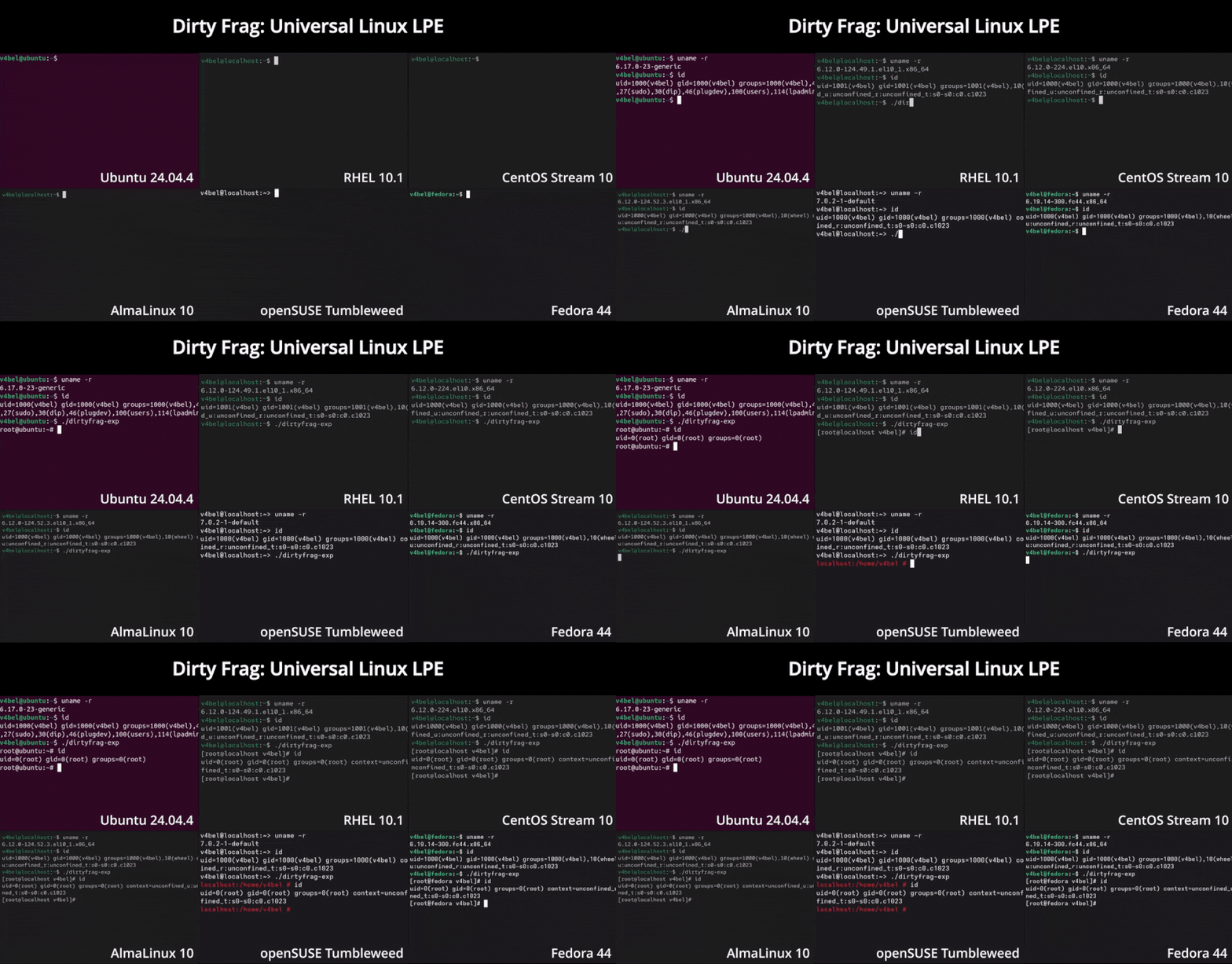
Image 1: Dirty Frag Proof-of-Concept screenshot
For security reasons, this blog post does not publish exploit code or an executable one-liner. The focus is on risk assessment, detection, hardening and management-level mitigation measures.
> Safe validation without exploit code 🔽 (Expand)
Security teams can start with a non-invasive inventory check:
uname -a
cat /etc/os-release
lsmod | egrep 'xfrm|rxrpc|af_alg'
systemctl --failed
find /proc/sys/kernel -maxdepth 1 -type f -print
These commands are intended for inventory purposes only and do not replace an official vendor advisory assessment.
Attack Path
Dirty Frag is especially dangerous because it can act as an escalation stage after initial access has already been obtained. In realistic attack scenarios, the vulnerability is therefore not necessarily the first step, but rather the critical step towards full system compromise.
| Phase | Description | Business Impact |
|---|---|---|
| Initial Access | The attacker obtains local access through compromised credentials, a web shell, a container-related weakness or a CI/CD agent. | Initial foothold on the system |
| Local Enumeration | Kernel version, distribution, modules and security profiles are assessed. | Evaluation of escalation options |
| Privilege Escalation | Dirty Frag is used to escalate from a normal user context to root. | Full system control |
| Persistence | Root access enables backdoors, SSH key manipulation, service modification or credential dumping. | Long-term compromise |
| Lateral Movement | The attacker moves to additional systems, Kubernetes nodes, databases or internal networks. | Expansion into an enterprise-wide incident |
Risk Analysis
🔐 Confidentiality
Root access allows attackers to read sensitive files, secrets, API tokens, SSH keys, database credentials and configuration files.
🧩 Integrity
Attackers may modify system files, applications, container images, logs or security agents.
⚙️ Availability
Root access can be used to disable critical services, sabotage systems, deploy ransomware or cause complete system outages.
🏢 Compliance
Impacted frameworks may include ISO 27001, NIS2, the Swiss ICT Minimum Standard, BSI IT-Grundschutz, NIST CSF and internal risk control requirements.
Immediate Mitigation Measures
Priority 1: Review Kernel and distribution advisories for all deployed Linux versions and apply available security updates with high priority.
- Patch the Kernel: Check vendor security updates for Ubuntu, Debian, RHEL, Fedora, SUSE, AlmaLinux, Rocky Linux, Amazon Linux and other distributions.
- Plan reboots: Kernel updates usually require a reboot or an approved live-patching process.
- Prioritise container hosts: Kubernetes nodes, Docker hosts and CI/CD runners should be reviewed first.
- Enable Seccomp: In Kubernetes, use
RuntimeDefaultwhere possible and avoidUnconfined. - Review User Namespaces: Restrict unnecessary User Namespace usage.
- Apply least privilege: Minimise shell access, local user privileges and service account permissions.
- Increase monitoring: Monitor suspicious local escalation attempts, Kernel module activity, unusual processes and SUID file manipulation.
Detection & Monitoring
Detecting Local Privilege Escalation attacks is challenging because they occur inside the system after initial access. Security teams should therefore combine Kernel, process, container and identity telemetry.
> Possible detection focus areas 🔽 (Expand)
- Unusual use of Kernel-related interfaces by normal user processes
- Suspicious processes that suddenly switch to UID 0
- Manipulation of SUID binaries or system-critical files
- Unexpected shells inside container workloads
- Deviations from Kubernetes Seccomp profiles
- New SSH keys, new local users or modified PAM / sudo configurations
- Disabling or manipulation of EDR, Auditd or logging components
# Example defensive checks
find / -perm -4000 -type f 2>/dev/null
last -a
lastlog
journalctl -p warning --since "24 hours ago"
auditctl -l
ps aux --sort=-%cpu | head
Strategic Recommendations for CISOs
1. Patch Governance
Critical Kernel vulnerabilities require an accelerated patch process with clear risk acceptance, reboot windows and exception handling.
2. Linux Hardening
Standardised Linux baselines, CIS Benchmarks, Auditd rules, EDR coverage and restrictive Kernel parameters should be implemented consistently.
3. Container Security
Kubernetes runtime security, Seccomp, AppArmor / SELinux, Pod Security Standards and node hardening must be reviewed and enforced.
4. Zero Trust
Local access must not automatically be considered trusted. Identities, workloads and administrative paths should be continuously verified.
Executive Conclusion
Dirty Frag once again demonstrates that Kernel vulnerabilities must not be treated as isolated technical issues. In modern IT, cloud and container environments, a Local Privilege Escalation vulnerability can become the decisive step from limited initial access to full compromise of critical systems.
Organisations should use Dirty Frag as a trigger to reassess Linux patch management, container runtime security, Kernel hardening and monitoring processes. Particularly exposed systems such as Kubernetes nodes, internet-facing servers, CI/CD infrastructure and administrative systems should be prioritised.
CRYPTRON Security GmbH – Linux, Cloud & Infrastructure Security
Do you need support in assessing your Linux, Kubernetes or cloud infrastructure? The CRYPTRON Security Team supports organisations with security assessments, hardening reviews, penetration tests and incident readiness.
Contact: Contact the CRYPTRON Security Team
Resources
- Dirty Frag – Research Repository
- The Hacker News – Dirty Frag Linux Kernel LPE
- Microsoft Security Blog – Copy Fail CVE-2026-31431
- Kubernetes Seccomp Documentation
© 2026 CRYPTRON Security GmbH. All rights reserved.