
RoguePlanet – Microsoft Defender Zero-Day Enables SYSTEM-Level Access
RoguePlanet is a publicly disclosed zero-day vulnerability affecting Microsoft Defender. Under certain conditions, a local attacker may escalate privileges to SYSTEM level on Windows 10 and Windows 11 systems.
Management Summary
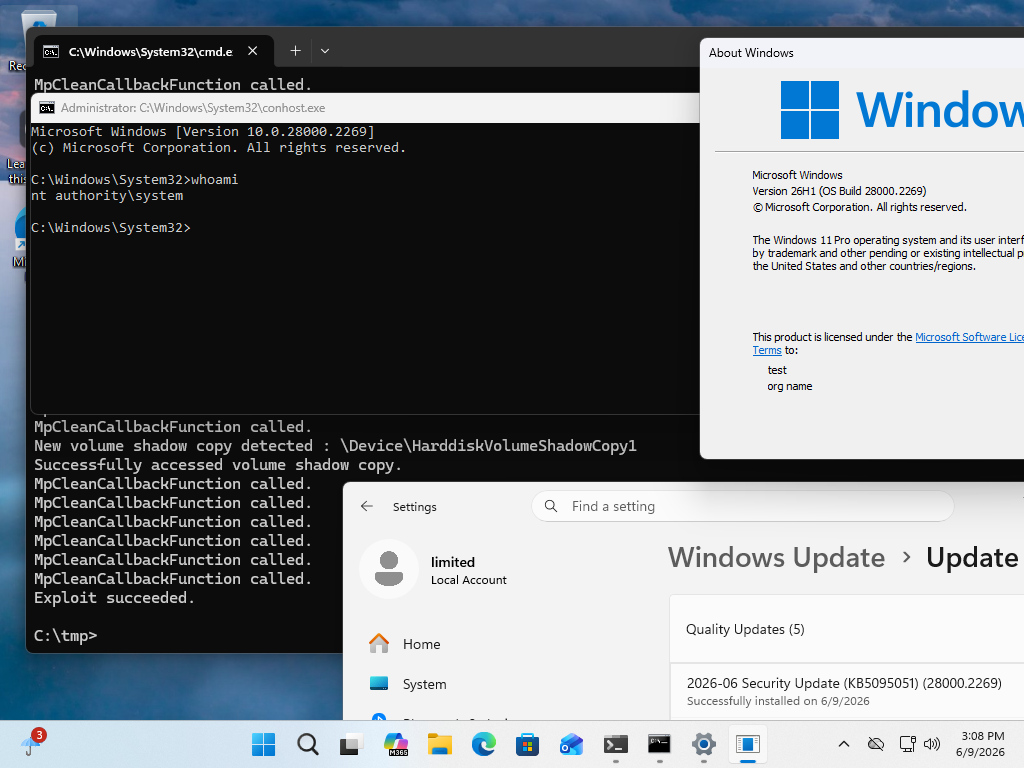
RoguePlanet is a local privilege escalation vulnerability affecting Microsoft Defender. The publicly available proof-of-concept leverages a race condition which, if successful, may result in a shell running with SYSTEM privileges.
Public reports indicate that the exploit may affect fully patched Windows 10 and Windows 11 systems with the June 2026 Patch Tuesday updates installed.
CISO Takeaway: RoguePlanet is not a traditional remote exploit. However, it represents a critical post-exploitation privilege escalation mechanism. Once an attacker obtains local code execution, the vulnerability may enable full endpoint compromise.
Technical Analysis
The vulnerability affects Microsoft Defender and appears to rely on a race condition. Exploitation reliability may vary between systems, although successful demonstrations have been publicly reported.
⚡ Race Condition
The attack abuses a narrow timing window within Defender processing. If the timing succeeds, the attacker may manipulate the security context and escalate privileges.
🛡️ Defender as Attack Surface
The case highlights that security products themselves can become part of the attack surface, especially when they operate with elevated system privileges.
Why is RoguePlanet particularly dangerous? 🔽
- SYSTEM Privileges: Successful exploitation grants the highest local privilege level on Windows.
- Patched Systems Affected: Public reports mention Windows 10 and Windows 11 systems with June 2026 updates.
- Post-Exploitation Value: Highly relevant after phishing, malware infection, compromised user accounts, or remote access.
- Security Tool Abuse: Microsoft Defender itself becomes part of the exploit chain.
Affected Systems
Based on publicly available information, RoguePlanet has been tested against Windows 10 and Windows 11 systems. Windows Server installations may also be technically affected, although the currently available proof-of-concept reportedly requires modifications for server environments.
| System Category | Risk Level | Notes |
|---|---|---|
| Windows 10 Clients | High | Public PoC reportedly tested successfully |
| Windows 11 Clients | High | Potentially affected despite June 2026 updates |
| Windows Server | Medium to High | Technical impact possible; PoC requires adaptation |
| VDI / Administrative Workstations | Critical | High-value targets with elevated access to internal systems |
Important: Continuously verify Defender versions, endpoint exposure, local user privileges, EDR telemetry, and Microsoft security advisories.
Proof of Concept
A public proof-of-concept has been released. For security reasons, this article does not include exploit code, GitHub references, or step-by-step exploitation instructions.
Attack Path
RoguePlanet is primarily relevant as a privilege escalation stage after initial access. An attacker first requires local code execution, but may then be able to escalate privileges to SYSTEM level.
| Phase | Description | Business Impact |
|---|---|---|
| Initial Access | Phishing, compromised user account, malware, remote access, or web shell. | Initial foothold on endpoint |
| Local Execution | The attacker executes code in a user context. | Preparation for escalation |
| Privilege Escalation | RoguePlanet is used to escalate privileges to SYSTEM. | Full local system control |
| Persistence | Manipulation of services, scheduled tasks, local administrators, or security tools. | Long-term compromise |
| Lateral Movement | Credential access, internal reconnaissance, and movement to additional systems. | Expansion into a broader security incident |
Risk Analysis
🔐 Confidentiality
SYSTEM privileges may allow access to local secrets, credentials, tokens, browser data, protected files, and security-sensitive configuration data.
🧩 Integrity
Attackers may manipulate system files, security configurations, services, local policies, Defender settings, or endpoint protection components.
⚙️ Availability
Security agents, Defender capabilities, business applications, or critical services may be disabled, degraded, or sabotaged.
🏢 Compliance
Potentially affected control frameworks include ISO 27001, NIS2, the Swiss ICT Minimum Standard, BSI IT-Grundschutz, NIST CSF, and internal risk control requirements.
Immediate Mitigation Measures
Priority 1: Closely monitor Microsoft Security Advisories, Defender platform updates, security intelligence releases, and endpoint telemetry for indicators related to RoguePlanet.
- Update Microsoft Defender: Verify security intelligence, platform, and engine versions.
- Reduce Local Administrator Rights: Review standard users, helpdesk accounts, and service accounts.
- Enable Attack Surface Reduction: Evaluate and deploy ASR rules wherever feasible.
- Enhance EDR Monitoring: Monitor for processes unexpectedly obtaining SYSTEM privileges.
- Prioritize Administrative Workstations: Assess PAWs, jump hosts, VDI environments, and IT administrator clients first.
- Review Incident Readiness: Validate containment, forensic, rollback, and communication procedures.
Detection & Monitoring
Detection efforts should focus on unusual process chains, Defender-related events, privilege escalation indicators, and newly spawned SYSTEM-level processes.
Possible detection focus areas 🔽
- Unexpected shells or script processes running with SYSTEM privileges
- Unusual Defender processes, scan activity, or file operations
- New services, scheduled tasks, or local administrator accounts
- Manipulation of Defender, EDR, logging, or audit components
- Suspicious ISO, VHD, or VHDX usage on client systems
- Credential dumping attempts after local privilege escalation
# Example defensive Windows checks
whoami /priv
whoami /groups
query user
net localgroup administrators
schtasks /query /fo LIST /v
sc query type= service state= all
Get-MpComputerStatus
Get-MpPreference
Get-WinEvent -LogName Security -MaxEvents 50
Strategic Recommendations for CISOs
1. Endpoint Hardening
Standardize Windows security baselines, Defender policies, ASR rules, Credential Guard, and Windows Defender Application Control.
2. Privileged Access
Restrict administrative activities to hardened Privileged Access Workstations and consistently remove unnecessary local administrator rights.
3. Detection Engineering
Create detection use cases for SYSTEM shells, Defender manipulation, new services, scheduled tasks, and suspicious process chains.
4. Vulnerability Governance
Formalize zero-day communication, emergency patching, exception handling, risk acceptance, and executive reporting processes.
Executive Conclusion
RoguePlanet demonstrates that endpoint security solutions themselves can become part of the attack surface. For organizations, this vulnerability is particularly relevant because it may allow attackers to escalate from initial local access to full SYSTEM privileges.
Organizations should use RoguePlanet as an opportunity to review Windows hardening measures, local administrative privileges, Microsoft Defender configurations, EDR detection use cases, and incident response capabilities.
CRYPTRON Security GmbH – Windows, Endpoint & Infrastructure Security
Do you require support assessing your Windows endpoint, Active Directory, or Microsoft Defender security posture? The CRYPTRON Security team assists organizations with security assessments, hardening reviews, penetration testing, and incident readiness activities.
Contact: Contact the CRYPTRON Security Team
Resources
- The Hacker News – RoguePlanet Microsoft Defender Zero-Day
- SecurityWeek – New Windows Zero-Day Exploit RoguePlanet Released
- Security Affairs – RoguePlanet on Fully Patched Windows
- Microsoft Security Response Center
© 2026 CRYPTRON Security GmbH. All rights reserved.